


If Southern trees could talk, what would they say?
First, acknowledge the beauty and brutality that have coexisted for centuries in nature
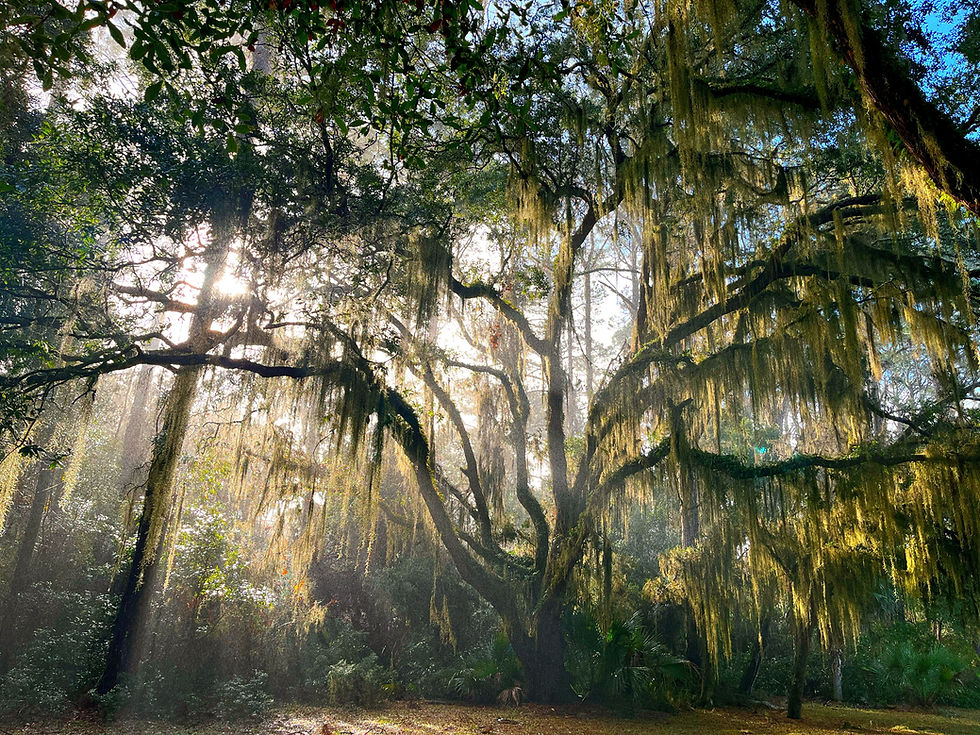
I've always been captivated by looking up at the sky. In the South, our skies painted in shades of blue, pink, and purple are lined with majestic oaks and expansive magnolias, while weeping willows sway with the slightest breeze, reminding us of their vitality.
In the South, beauty and brutality seem to work in a sort of symbiosis. The oak doesn’t tell us the events beneath it, the magnolia doesn’t reveal whose blood nourished its roots, and the willow doesn’t recount what it has witnessed. They simply grow, layer upon layer. And my wonder became layered too: with grief, pain, confusion, anger, sadness.
As a child, I gazed at those trees with awe. They felt almost otherworldly to me, as if out of the fantasy novels I so often lost myself in. I saw them as ancient and magnificent beings, standing long before my time and destined to be there long after.
The inevitability called time aged me and my fascination with those trees lived on, though my wonder evolved. They transformed from fantasy symbols to a blend of beauty and horror. With age comes knowledge; and with knowledge comes radicalization.
I started to ponder what these trees might have witnessed. The older I grew, the harder it was to look at the Southern landscape without acknowledging that its beauty and brutality have coexisted for centuries. When I look at the purple hues in cotton fields, I'm reminded that once this purple turned to white, then the white to red from the bloody fingertips of the enslaved.
In the South, beauty and brutality seem to work in a sort of symbiosis. The oak doesn’t tell us the events beneath it, the magnolia doesn’t reveal whose blood nourished its roots, and the willow doesn’t recount what it has witnessed. They simply grow, layer upon layer. And my wonder became layered too: with grief, pain, confusion, anger, sadness.
Eventually, a single question was at the forefront of my thoughts: If Southern trees could talk, what would they say?
Would they speak of enslaved Africans who gazed up at the same sky, dreaming of freedom beyond the horizon? Longing for a home they could no longer remember? Would they speak of the melodies that echoed through the fields or the sound of footsteps racing towards liberation? And what about the people who chased them?
Would they speak of Black communities that thrived despite all, creating jubilee? Would they speak on how often Black people were told they didn’t belong on land their ancestors had nurtured with their blood, with even the trees themselves weaponized against them?
Would they tell us of the gatherings when white people arrived in mobs? Of the ropes and flames? Who acted out the violence? Who smiled and jeered in joy under the hanging feet of Black men, women and children? Who looked away in cowardice?
And would they reveal how often the people who committed these acts went home to sit under the same trees, admiring the same sky, living life as if nothing had occurred?
The trees possess a memory that some want to distance themselves from; they remember even when Southern residents prefer to forget. They remember when history is squeezed into textbook paragraphs, when monuments are polished as “heritage” symbols, when murders become footnotes and victims remain unknown names and non-investigated deaths.
In 2026, the trees bear witness to the names Kyle Bassinga, Juliana Umba Nzita, To'Nea Nicole Miller, Justice Kai James, Jerard Jackson, Tasia Fortune, Demetrius Fleming and Earl Smith, and several other victims that remained unidentified. These deaths, all found under hanging or ligature conditions, were quickly closed by authorities, labeled as suicides before the bodies grew cold with the finality of the morgue. Their families and civil rights activists refuse to let these lives fade into silent statistics by pushing against swift rulings, demanding independent investigations and real accountability.
The branches continue to hold these realities, and the refusal to properly investigate these modern tragedies reinforces the truth that the violence witnessed by these ancient trees is far from a relic of the past.
The land doesn’t need a government sanctioned historical plaque to remember the past because the ground and water hold the memories. And the trees remember.
Maybe that's why I keep choosing to look up. Somewhere between being a girl who saw magic in their branches and a woman who understands what they've witnessed, I've realized something: the trees were never silent; I simply hadn't learned how to listen.
But I'm listening now.
And what's most haunting is that these trees not only bear memories from generations ago. They bear witness to our realities today, where anti-Black violence remains constant. The methods may evolve, the language may change, the justifications may shift.
As the trees do not forget, we must not forget.
The trees teach us something about how to carry that memory forward. Be persistent like the layers of an ancient oak; resilient like its roots, buried deep enough to hold when the storms come. Find joy and life like the willow, bending without breaking beneath the weight of the wind. And preserve your beauty like the blossoming magnolia, its roots ever resilient.
But the question remains: Who gets to live beneath these trees in peace? Who gets to be believed? Who gets to go home to their loved ones?
If Southern trees could speak, what would they say?
“Black people do not hang themselves from trees.”


Comments